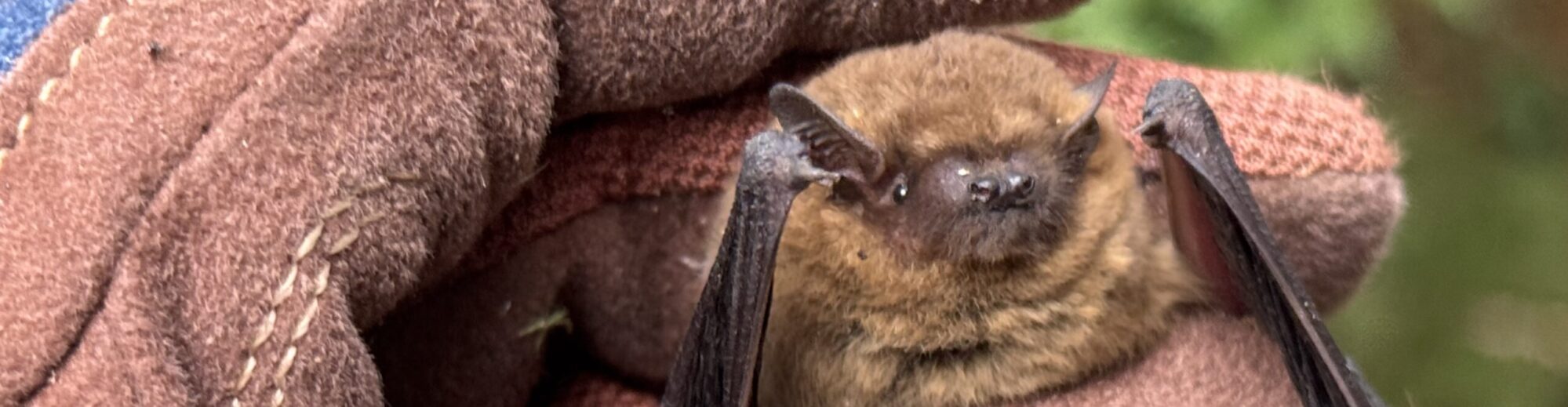
In this region we are very luck to have a number of bat species throughout the region. We thought this section would be a great resource for all to find out more on those bats that you may see. The majority of descriptions are from the Bat Conversation Trust and can also be found here.
All photos were taken in Dumfries and Galloway during bat box checks over the last few years.
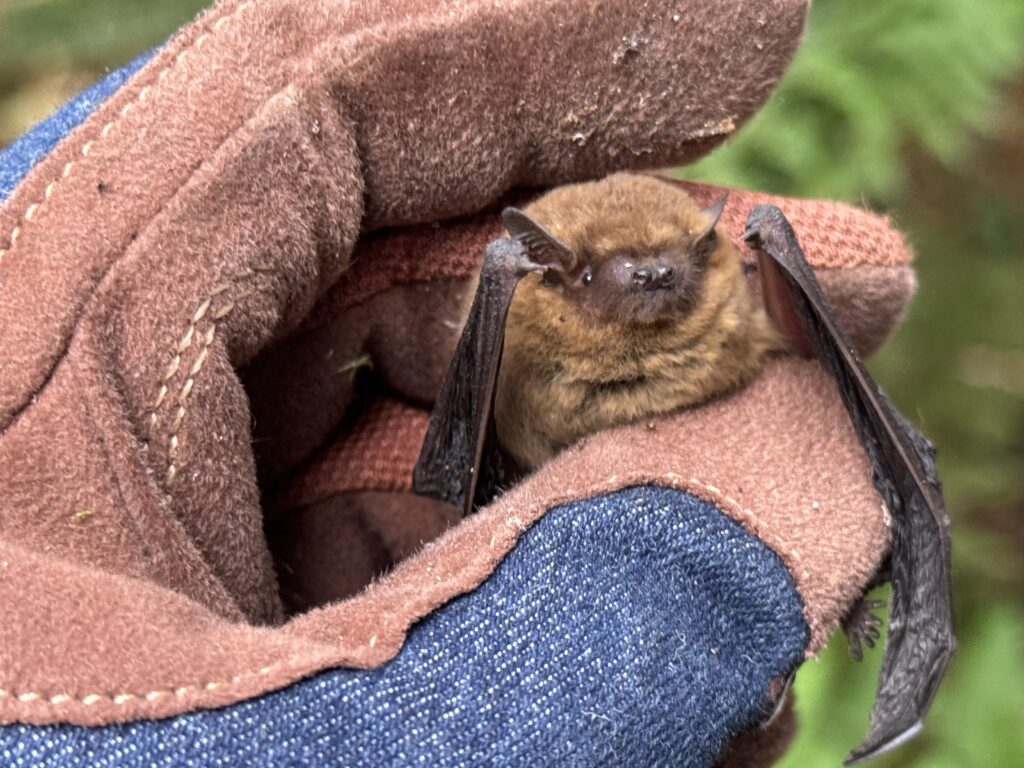
• Soprano Pipistrelle
(Pipistrellus pygmaeus)
The soprano pipistrelle is one of the commonest and most widespread of all British bat species.
It is very similar to the common pipistrelle but has a paler face and it echolocates at a higher frequency.
• Bandit (Common) Pipistrelle
(Pipistrellus pipistrellus)
The common pipistrelle is one of the commonest British bats, weighing around 5 grams (same as a 20p piece). A single pipistrelle can eat thousands of tiny insects in just one night! They are the species you are most likely to see around your garden.
The Soprano is actually more common in Scotland and hence why often we refer to is as a Bandit.
• Nathusius’ Pipistrelle
(Pipistrellus nathusii)
Nathusius’ pipistrelle is a rare bat in the UK, though records have increased in recent years. It is a migratory species, and most bats are encountered in autumn, although some do remain all year and breed in the UK.
It is similar in appearance to, but slightly larger than the much more commonly found common and soprano pipistrelles, and the fur on its back is longer, sometimes giving a shaggy appearance.
• Brown Long-eared
(Plecotus auritus)
Brown long-eared bats are medium-sized with ears nearly as long as the body. However this is not always obvious: when at rest they curl their ears back like rams’ horns, or tuck them away completely under their wings leaving only the pointed inner lobe of the ear (the tragus) visible.
This bat’s huge ears provide exceptionally sensitive hearing – it can even hear a ladybird walking on a leaf!
• Whiskered
(Myotis mystacinus)
Whiskered bats have shaggy dark grey or brown fur and dark face and dark ears.
They are part of what is called the ‘small Myotis’ group, which includes Alcathoe and Brandt’s bats. Other distinguishing features are the tragus shape and the male’s reproductive organs.
• Daubenton’s
(Myotis daubentonii)
Known as the ‘water bat’, Daubenton’s bats fish insects from the water’s surface with their large feet or tail. Daubenton’s bat is a medium-sized species. It has a steady flight, often within a few centimetres of the water surface and is reminiscent of a small hovercraft.
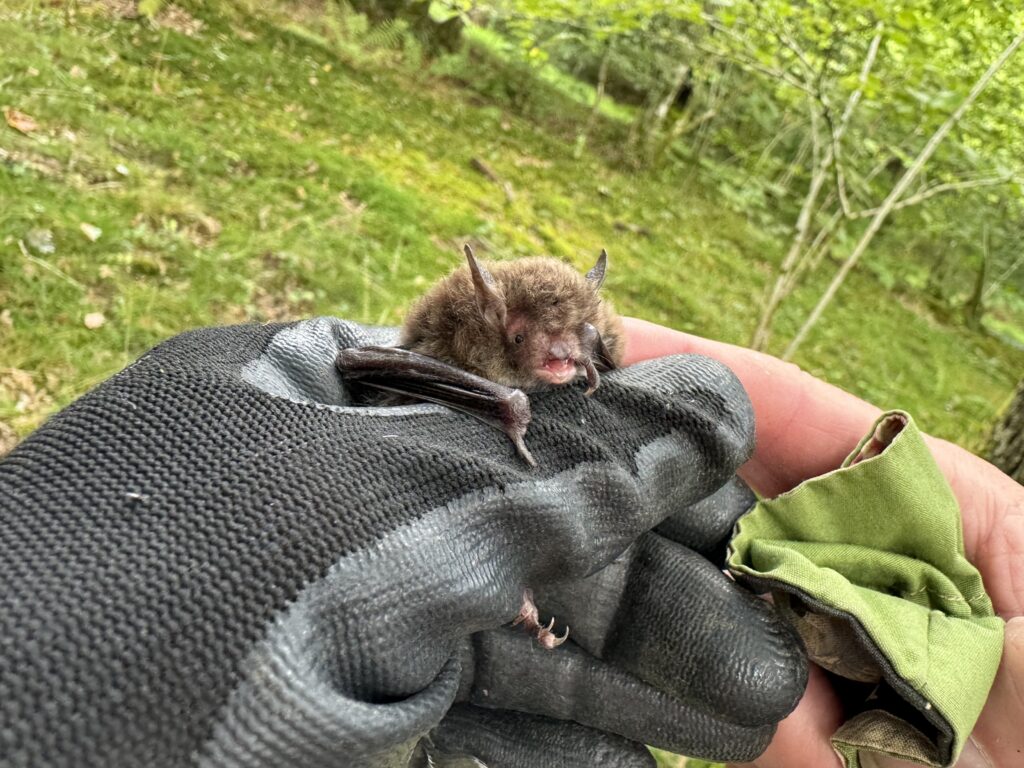
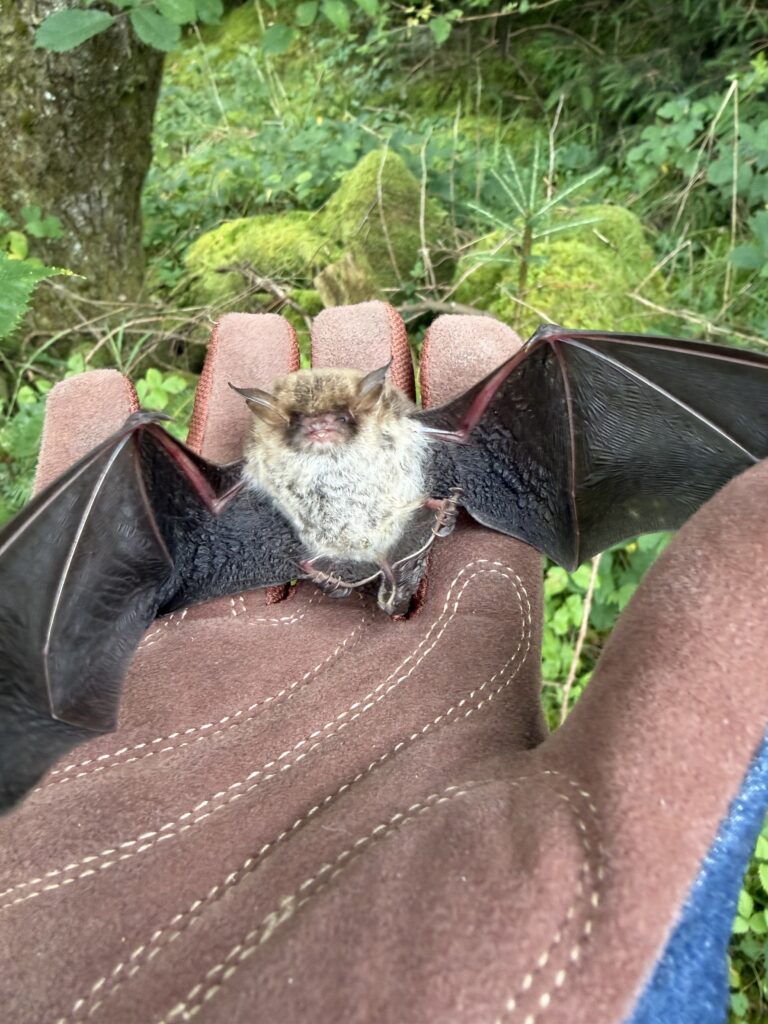
• Natterer’s
(Myotis natteri)
The Natterer’s bat has broad wings which enable it to fly slowly and prey on a wide variety of insects, even snatching spiders from their webs!
The ears are narrow, fairly long and slightly curved backwards at the tip. The inner lobe of the ear (the tragus) is long, narrow and sharply pointed. A characteristic feature of the Natterer’s bat is a fringe of very stiff bristles along the trailing edge of its broad tail membrane. Its rather pinkish limbs give rise to its old name of ‘red-armed bat’.
• Noctule
(Nyclatus noctula)
The noctule is one of the largest British species, about the length of the palm of your hand (if you have reasonably large hands!).
Noctules have broad brown ears and a distinctive mushroom-shaped tragus. This bat has long narrow wings and flies in a straight line, very high and fast.
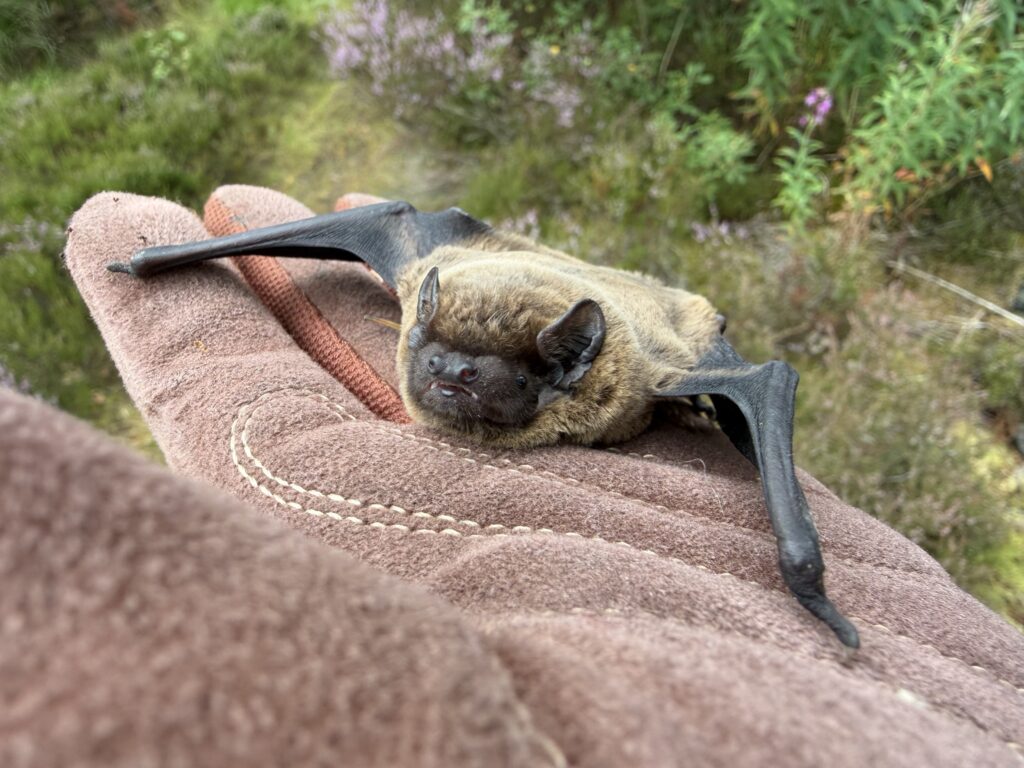
• Leisler
(Nyctalus leisleri)
The Leisler’s bat is also known as the ‘hairy-armed bat’. It has a lovely long fur, particularly around the shoulders and the upper back, giving it a lion’s mane appearance.